
For entertainment agencies and wedding entertainers
Software for entertainment agencies and wedding entertainers
Three weeks before the wedding the couple move the first dance. The office knows. The DJ is still working from the running order he was sent a month ago, and finds out at the venue.
What it looks like running
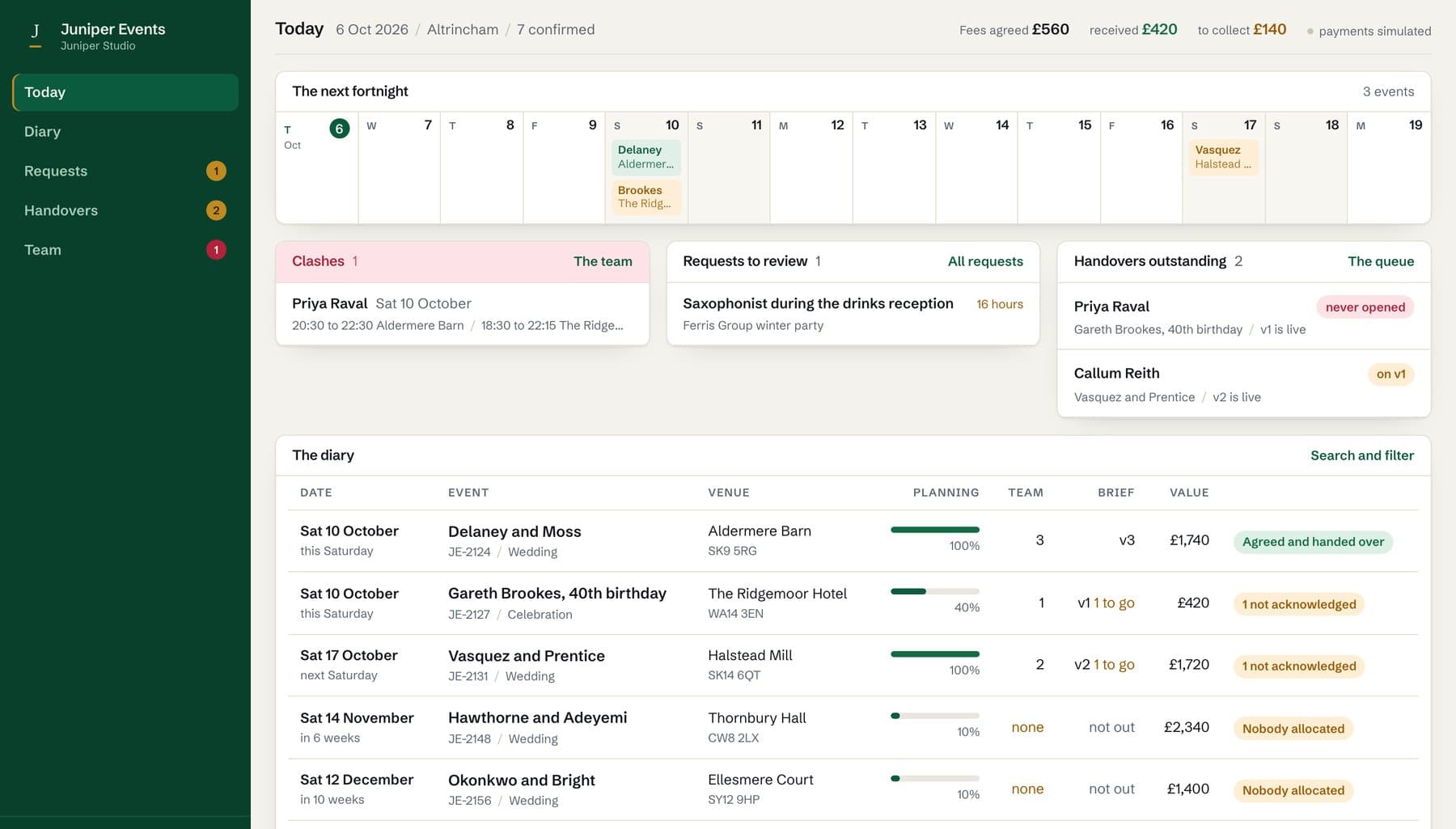
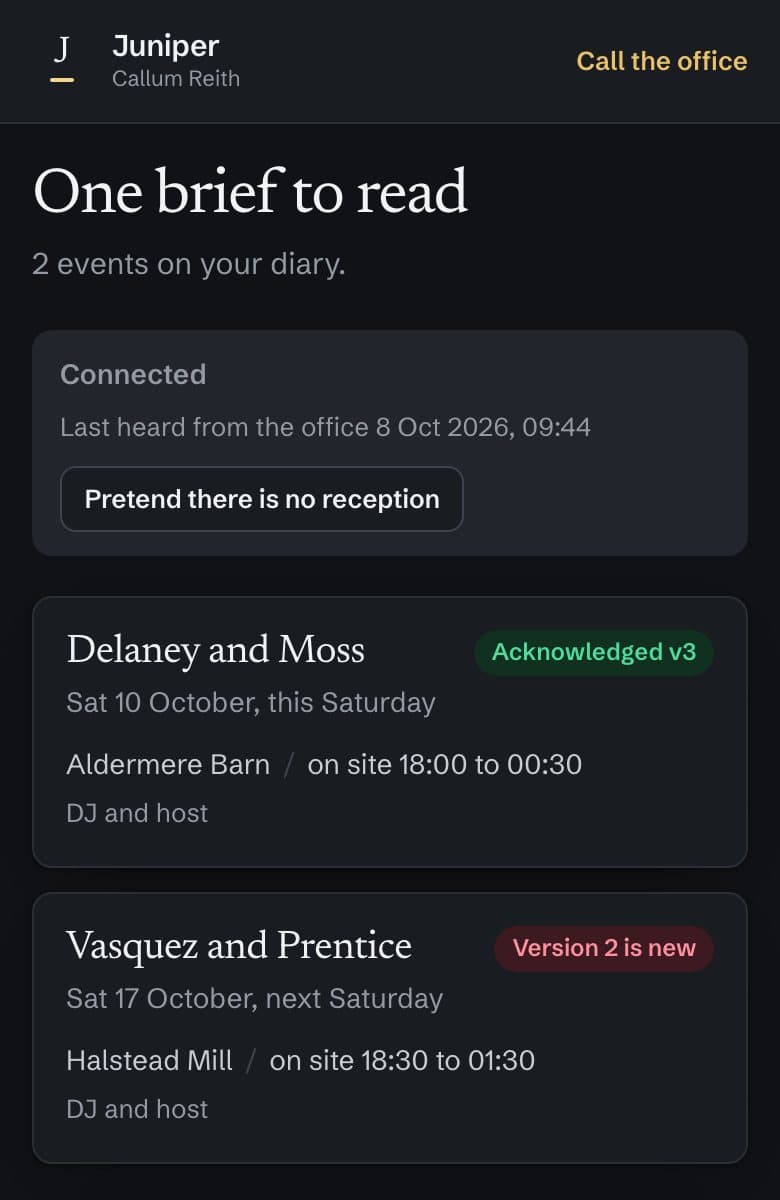
Juniper is a demonstration we built for an invented wedding and events entertainment supplier. The office screen holds the diary, the clashes, the client requests waiting on a price and the briefs nobody has opened. The phone screen is the DJ's, with one brief per event and a version number on each.
How these businesses run
An agency sells acts: DJs, hosts, bands, saxophonists. Each booking pairs a client with one or more performers, often months before the night.
Between the booking and the event the details change. Times move, extras get added, the venue changes its rules. Each change has to reach the office, the client and the performer, and match in all three places.
On the night the performer is on their own, often somewhere with poor signal, working from whatever they were last sent.
Where it usually goes wrong
- Enquiries arrive without a date, a venue or a budget, so the first reply is three questions
- A couple asks for an extra hour on WhatsApp and nobody prices it
- The performer turns up with last month's running order
- Two acts are pencilled in for the same Saturday and nobody spots it until the week before
- Deposits and balances live in a spreadsheet one person understands
- Nobody knows whether the performer actually read the final brief
Sound like your business?
Tell us which of these costs you the most time and we will tell you what we would build, roughly what it would cost and how long it would take.
What we can build for this
What we can build for this kind of business. The work already delivered is further down the page.
- An enquiry form that asks what your office would ask and files the booking into your diary
- A diary showing every act, every date and every clash across the agency
- Client requests priced and accepted before anything changes in the plan
- A planning page for each couple, with their answers going straight into the brief
- Numbered briefs, so everyone knows which version they are working from
- Performers confirming they have read the latest version, with the office able to see who has not
- A performer screen that still opens with no signal at the venue
- Deposits, balances and what is left to collect against each booking
- Artist pages with video, edited by your own team
How a project would work
We would start with one booking that changed after it was confirmed, followed from the request to the night. It shows exactly where the versions split.
The client's page and the performer's screen are built alongside the office, not after it. A brief that nobody reads on the night is not finished.
Ready to see what it would take?
Watch the short briefing first, or book a review and talk it through with us.
Work we have delivered in this market
See it working
A short film of one of our own demonstrations, recorded from the running software. Every company in it is invented, and the link opens the real thing.
Juniper Events · Weddings and events entertainment
An extra hour asked for, priced, accepted, and only then added to the plan, with the brief reissued and acknowledged before the day counts as handed over.
Things we have already built
Live in software we have delivered, and relevant to this kind of business. Part of the 123 things we have built.
Multi-step booking with email and planner sync
Every enquiry is captured, confirmed by email, and dropped straight into the booking system, so no lead slips through the cracks.
Artist profile pages with video and social media
Prospective clients explore each performer in detail on the site, see real video and real reviews, and enquire with confidence. Instead of asking for a showreel by email.
Automated review and testimonial collection
Social proof builds steadily from happy clients without the owner personally asking each one.
Self-serve content studio
The owner keeps the site current on their own schedule, with no developer needed for everyday changes.
What that usually means building
Questions we get asked
- Can couples see their booking without ringing the office?
- Yes. Each couple gets their own page with their planning form, their running order and a way to ask for a change. A change they ask for is priced and accepted before it goes into the plan.
- How do I know a performer has read the latest brief?
- Every brief has a version number. When a new version is published the performer is asked to confirm it, and the office can see who has confirmed and who has not.
- Have you built for an entertainment business before?
- Yes. We built the booking site for The DFC Experience, a wedding and event entertainment company: artist pages with video, a booking form that asks what a planner would ask, and a studio their own team uses to edit the site.
Tell us how your business actually runs
We build around the way the work already happens rather than fitting a business to software that was written for somebody else. Describe the part that costs you the most time and we will tell you what we would build and roughly what it would cost.