Being understood
Written for the worried
Service pages in the words clients use, not the words the profession uses. One page per service, so search sends people to the answer rather than to a list they have to read through.

For accountancy practices
They choose the one that sounds like it understands them, usually while something has already gone wrong. A site that lists services in the language of the profession asks a frightened person to translate before they can trust you. We build the other kind: plain English, real proof, and one obvious next step on every page.
Credibility, not price
That is the whole brief. Somebody with a letter from HMRC on the table is not comparing hourly rates, they are looking for the practice that sounds like it has seen their exact problem before and is not going to make them feel stupid about it. Price only becomes the deciding factor when nothing else on the page separates you from the firm two streets away.
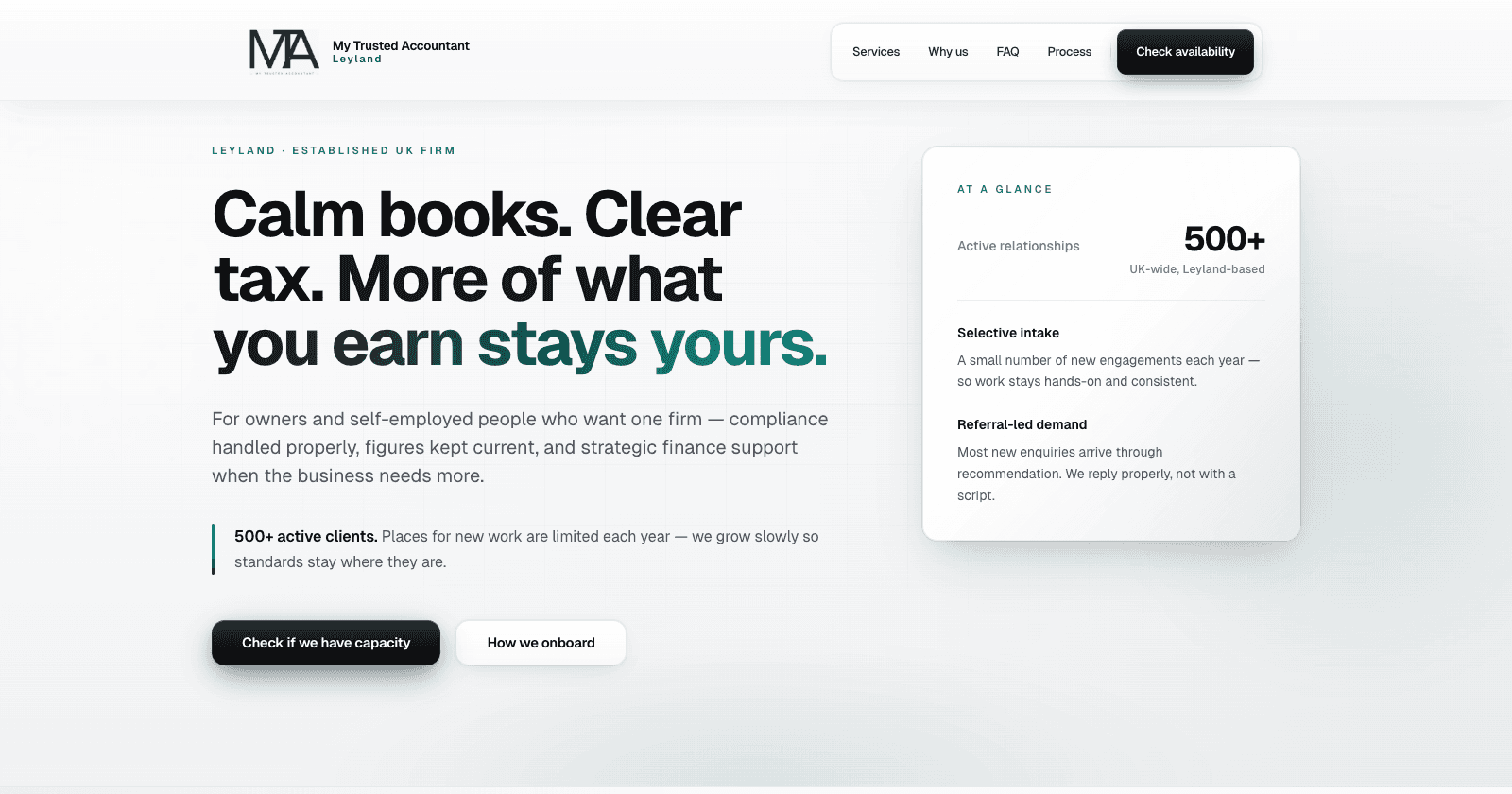
So My Trusted Accountant was rebuilt to lead with credibility: every service in plain English on a page of its own, so somebody searching for the one thing they are anxious about lands on a page about that thing. Client words run through the site rather than sitting on a testimonials tab nobody clicks.
And nothing measures a visitor until they have agreed to it. A practice that advises on compliance cannot be the one quietly loading trackers before the banner appears.
What we build
Not a redesign for the sake of it. Three changes that decide whether a worried visitor gets in touch or carries on looking.
Being understood
Service pages in the words clients use, not the words the profession uses. One page per service, so search sends people to the answer rather than to a list they have to read through.
Being believed
Real client words next to the service they are about, a visible company identity, and no stock photography of handshakes. Credibility is cumulative and it is built out of small, checkable things.
Being contacted
Every page ends the same way, so an enquiry never depends on somebody hunting for a contact form. Enquiries route to a person, not to a shared inbox nobody owns.
Behind the website
A client's year usually arrives as email attachments, a bag of receipts and a list of what is still missing. We also build the other side: a portal for each client, and links that need no login, so they can see what you need, sign the engagement letter and pay the invoice.
On paper. A folder, an inbox and a sticky note of what is missing.
In the portal. The same client, in one place they can open any time.
Hartwell Pike and Brindle Street Bakery are made up examples.
The proof
One client, written up in full: what they were up against, what we changed, and the reason behind each decision.
Accountancy practice, Leyland
A trust-led rebuild for a practice competing on credibility rather than price.
That is not all of it. See every project we have written up, or the feature-by-feature catalogue of what is running inside them.
Before you book
See the practice we rebuilt, how projects are scoped and when we would recommend fixing an existing site instead. Then decide whether a conversation would be useful.
A practical briefing from Ownly, real work you can open, and straight answers on cost, timing and fit. No email is needed.
Asked every time
Tell us what your site is doing now and who you are competing with, and we will tell you what would change it, what it would roughly cost, and whether it is worth doing at all.